

dental bridges
A dental bridge is a false tooth that is used to fill the gap created by missing tooth or teeth. A gap between your teeth can be potentially dangerous to your dental health, as it can cause your teeth to shift resulting in a change in your bite that could be painful. Dental bridges help alleviate this problem by using the two surrounding teeth as anchors to hold a false tooth in the place where the gap is. Typically, porcelain crowns are placed over the surrounding teeth, and the false tooth, known as a pontic, is fused between them.
Types of dental bridges
There are three types of dental bridges that are commonly used today
1. Traditional fixed bridge - This is the most common type of dental bridge, in which porcelain crowns are placed over the two surrounding teeth and used as anchors to hold the fale tooth in place. The false tooth is usually made of either porcelain fused to metal or ceramics.
2. Cantilever bridge – A cantilever bridge is used when teeth are present on only one side of the gap. These are used typically in areas of your mouth that doesn’t experience an intense chewing load, such as your front teeth.
3. Resin-bonded bridge - In a resin-bonded bridge, metal bands are bonded to the surrounding teeth with resin and used to hold a plastic false tooth in place. This type of bridge is typically used in areas of the mouth that undergo less stress, such as the front teeth.
How it's done
A minimum of two visits are required for placing a dental bridge. At the first visit, three important steps are completed. Firstly, the surrounding teeth are prepared to be fitted with a crown. This may including filing down the tooth so that the crown can fit over it. Secondly, an impression is taken of your teeth which will be sent to a laboratory to prepare the bridge and crown. Finally, the dentist fits your teeth with a temporary bridge to protect them while the bridge is prepared at the laboratory.
At the second visit, the temporary bridge is removed and the new bridge received from the laboratory is fitted and adjusted. Multiple visits may be necessary to check and adjust the fit.
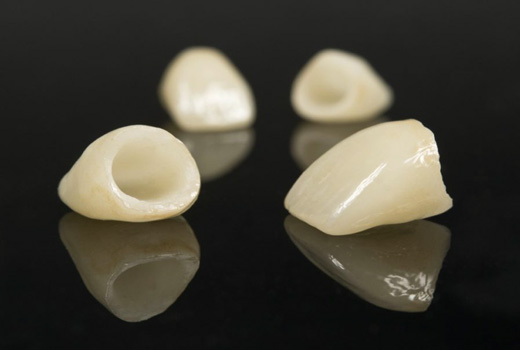
Porcelain Crowns
Compared to fillings which just cover a small portion of a tooth, a crown (or cap) encases the entire visible portion of a tooth. In effect, the crown acts as the tooth's new outer surface.A dental crown is used when a tooth is broken or decayed to such an extent that fillings aren't able to repair the problem. The crown is able to provide a protective shell around the damaged or decayed tooth to strengthen it, as well as to improve the appearance of the tooth. They can also help restore a tooth to it's original shape, are used commonly for teeth that have been broken. While crowns come in different materials, the most common crowns typically have some mixture of porcelain in them to give them a look and feel similar to a natural tooth.
How it's done
The first visit to your dentist involves reshaping the tooth and taking impressions to create the crown. Typically a portion of you tooth will have to be removed for the crown to fit properly. After the dentist reshapes your tooth, he will use a special material to create an impression of it. This impression will be sent to a dental laboratory to be made into a permanent crown. Before sending you home, the dentist will provide you with a temporary crown to cover your tooth in between visits.
When you return to you dentist, he will have received the permanent crown from the laboratory. He will remove the temporary crown and fit the new permanent one. Before cementing the permanent crown in place, he will ensure that it fits comfortably and matches the color of your teeth.
Frequently Asked Questions
Q. What is the difference between a dental crown and a dental bridge?
A. A dental crown is a custom cap that covers a damaged or decayed tooth to restore its shape, strength, and appearance. A dental bridge replaces one or more missing teeth by anchoring a false pontic tooth between crowns on adjacent healthy teeth. Crowns protect individual teeth, while bridges fill gaps left by missing teeth.
Q. Why might I need a dental crown?
A. You may need a crown if a tooth is:
- Severely decayed or broken
- Cracked or weakened
- After a root canal
- Misshapen or worn down
Crowns restore function and help prevent further damage.
Q. What are dental bridges used for?
A. Dental bridges are used to replace missing teeth, which helps:
- Maintain proper bite and chewing function
- Prevent surrounding teeth from shifting
- Improve speech and smile appearance
Bridges are a reliable solution for one or more missing teeth when neighboring teeth are healthy enough to support them.
Q. How long do crowns and bridges last?
A. With proper oral care (brushing, flossing, routine cleanings), crowns and bridges can last 10–15 years or longer. Longevity depends on material choice, bite forces, oral hygiene, and regular dental visits.
Q. What materials are crowns and bridges made from?
A. Crowns and bridges are commonly made from:
- Porcelain – natural appearance
- Porcelain fused to metal – strength + esthetics
- Ceramic – strong and highly aesthetic
Our practice uses materials chosen for durability and a natural look that matches your smile.
Q. How are crowns and bridges placed?
A. The process usually takes two visits:
- Preparation & impressions – Teeth are shaped, and a mold is taken. A temporary restoration is placed.
- Final placement – The customized crown/bridge arrives from the lab and is bonded in place once fit and color are confirmed.
Q. Is getting a crown or bridge painful?
A. Most patients experience minimal discomfort. Local anesthesia is typically used during tooth preparation, and many report little to no pain afterward. Recovery is quick with proper care.
Q. How do I care for my crown or bridge?
A. To extend the life of your restoration:
- Brush twice daily
- Floss daily (especially under bridges)
- Visit the dentist regularly
- Avoid very hard foods that can chip or damage restorations
Good hygiene helps prevent decay and gum disease around the restoration.
