
What Are Overdentures?
Missing teeth can affect both your self-assurance and overall health, hindering your ability to eat well and obtain essential nutrients. Here at Smiles By Design, Hewlett, NY, we provide overdentures to aid in restoring your missing natural teeth, enhancing your well-being.
While overdentures present a promising alternative to conventional dentures, they might not suit everyone. Explore further to understand overdentures better and determine if they are the right choice for you.
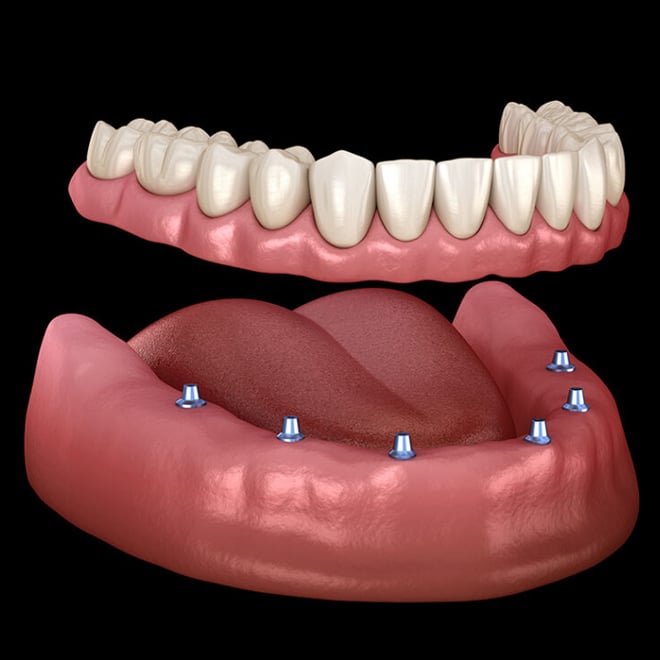
Similar to conventional dentures, overdentures serve as dental prosthetics to address the issue of missing teeth. While regular dentures rest on the gum line of the former natural teeth and rely on suction or adhesive for stability, overdentures are supported by dental implants, providing a more natural sensation. This added support enhances comfort in eating, drinking, and speaking compared to traditional dentures.
Overdentures offer flexibility—they can be either fixed or removable and are available in various types, encompassing both full and partial sets. During a consultation, your dentist will explore these options with you, considering your specific needs and budget.
Types of Overdentures
Implant-supported overdentures stand as the predominant type among the various available forms of overdentures.
Implant supported overdentures
A removable version of overdenture, the implant-supported type, allows for nightly removal and cleaning. It relies on two to six dental implants affixed to your jawbone, not only supporting the overdenture but also contributing to the jaw's health maintenance.
Fixed implant supported overdentures
In contrast to typical removable implant-supported overdentures, these variants are fixed to the implants using screws and cannot be removed without a visit to your dentist. The upside of fixed implant-supported overdentures lies in their enhanced stability.
Bar-retained implant-supported overdentures
Rather than connecting directly to regular implants, these overdentures are clipped onto a bar affixed to the implants. This design enables easy removal as necessary while ensuring security and stability during your daily activities.
Ball-retained implant-supported overdentures
Spherical attachments linked to the implant provide support for the overdentures, offering greater stability compared to conventional implant-only supported ones. Additionally, these are removable, allowing for convenient cleaning as required.
Overdenture partials
In cases of partial tooth loss, overdenture partials might suffice, replacing a small section of missing teeth using just one or two implants.
Overdenture Procedure
The journey to acquiring overdentures starts with a consultation with your dentist, assessing your candidacy and aligning treatment goals. Once confirmed suitable for overdentures, the next phase involves implant placement.
Dental implants are strategically positioned in your jawbone based on your individualized treatment plan. Following implant placement, a healing period, which can span several months, might be necessary. Your dentist may suggest temporary dentures during this phase to aid in eating.
Post-healing, abutments are affixed atop the implants to which the overdentures will attach. Your dentist will take mouth impressions to craft custom-fitted overdentures.
Upon completion, the overdentures are fitted to ensure daily comfort. Should any discomfort arise, inform your dentist for adjustments to ensure a proper fit. While an adjustment period is expected, they shouldn't cause pain. Regular follow-up appointments allow your dentist to assess the fit and address any concerns.
Benefits of Overdentures
Opting for overdentures to replace missing teeth offers numerous advantages, surpassing those of traditional dentures.
Despite being pricier compared to traditional dentures or standard tooth implants, overdentures hold the potential to significantly enhance your quality of life, closely resembling natural teeth.
Stability
The primary distinction between overdentures and traditional dentures lies in their stability. Overdentures are securely anchored to an implant, ensuring they stay firmly in place. This eliminates concerns about dentures slipping or shifting during your daily activities.
Easier Eating & Speaking
Thanks to the increased stability, overdentures enable you to comfortably consume harder foods compared to what's typical with dentures, promoting easier digestion. Additionally, they facilitate more natural-feeling conversations, enhancing your mouth's comfort during interactions.
Bone Retention
When teeth are missing, bone loss can cause the jawbone to shrink. Overdentures, by utilizing implants placed in the bone, counteract this deterioration, preserving the bone and maintaining your natural facial contours.
Long Lasting
With appropriate maintenance, overdentures tend to outlast traditional dentures. Over time, jaw shifting due to bone loss necessitates denture replacement. Overdentures, by preventing bone loss, contribute to maintaining the same set for an extended period.
How Much Do Overdentures Cost?
One drawback of overdentures is their potential to incur higher costs compared to traditional dentures. The expense depends on factors such as the chosen type, insurance coverage, number of teeth replaced, and any required extractions. Additionally, material selection and procedural complexity contribute to determining the overall cost.
Costs can range from a few thousand dollars to well over ten thousand dollars, varying with each individual treatment. Hence, discussing your specific treatment needs with your dentist and consulting your dental insurance regarding coverage is crucial.
Are Overdentures Right For You?
For many individuals, overdentures present an excellent alternative to traditional dentures, offering enhanced stability and durability for a more natural mouth feel and appearance. However, not everyone qualifies for this treatment.
To be considered for overdentures, good overall health is essential for the implant surgery, along with maintaining excellent oral health. Strong bone density, tooth loss, and a commitment to regular maintenance are also pivotal factors in determining candidacy.
Strong Bone Density
To provide support for the overdenture, robust implants necessitate a sturdy jawbone. Your dentist will assess its strength via imaging during your initial consultation. Insufficient jawbone may still allow for overdenture placement through a bone graft procedure.
Missing Teeth
To qualify as a suitable candidate for overdentures, multiple missing teeth or the absence of all teeth is necessary. If only one tooth is missing, your dentist may lean toward recommending a standard implant instead. Additionally, any remaining natural teeth should be in good condition to assist in supporting the overdentures.
Ability to Keep up with Maintenance
Overdentures demand diligent upkeep to sustain functionality and prevent deterioration. This involves nightly cleaning, including brushing and soaking, alongside regular removal to allow your gums to breathe, averting bacterial buildup. Inability to maintain overdentures may prompt exploration of alternative teeth replacement solutions.
Your dentist, considering your health history and oral condition, will assess your candidacy for overdentures. For more information or to explore overdenture options, reach out to us for a consultation to address all your queries.
Frequently Asked Questions
Q. What are overdentures and how do they differ from traditional dentures?
A. Overdentures are a type of dental prosthetic used to replace missing teeth. Unlike traditional dentures that rest on the gums and rely on suction or adhesive for stability, overdentures are supported by dental implants placed in the jawbone. This offers superior comfort, stability, and function — making eating, speaking, and smiling more natural.
Q. Who is a good candidate for overdentures in Hewlett, NY?
A. Ideal candidates are patients with multiple missing teeth or a fully edentulous arch who have adequate bone density and good overall oral health. During your consultation at Smiles By Design, our dentists will evaluate your jawbone, mouth condition, and personal goals to determine if overdentures are right for you.
Q. What types of overdentures are available?
A. The main types include:
- Implant-supported overdentures – removable and snap onto implants for daily cleaning.
- Fixed implant-supported overdentures – permanently attached with screws for maximum stability.
- Bar-retained overdentures – clip onto a metal bar connected to implants.
- Ball-retained overdentures – use spherical attachments for secure fit.
- Overdenture partials – ideal when only a section of teeth is missing.
Q. How long does the overdenture process take?
A. The process begins with a consultation and imaging to assess bone structure. Implant placement is scheduled next, followed by a healing period (usually several months) to allow osseointegration (bone-to-implant bonding). Once healed, abutments are placed and impressions are taken for custom overdentures. Individual timelines may vary based on health and treatment needs.
Q. Do overdentures feel natural?
A. Yes. Because overdentures are anchored to implants in the jawbone, they feel more secure and natural compared to traditional dentures. Patients report improved comfort when speaking and eating hard or chewy foods.
Q. Are overdentures more expensive than traditional dentures?
A. Generally, overdentures cost more than conventional dentures due to the implant placement and surgical steps involved. However, because they offer greater stability, bone preservation, and long-term durability, many patients find they’re a worthwhile investment in oral health and quality of life. Costs vary based on the number of implants, type of overdenture, and any necessary preparatory treatments.
Q. Is the overdenture procedure painful?
A. Most patients experience minimal discomfort during implant placement thanks to modern sedation and anesthesia options. Post-operative discomfort is usually manageable with prescribed pain control measures. Our team at Smiles By Design ensures your comfort throughout the process.
Q. How do I care for my overdentures?
A. Care includes daily cleaning, nightly removal (if removable), and routine dental check-ups. Good oral hygiene and regular visits help maintain implant health and prolong the life of your overdentures.
